
Gurjar History
– A Legacy of Knowledge, Courage & Civilization
1. Introduction
The Gurjar (Gurjara / Gujjar / Gurjar) community holds one of the oldest and most influential places in the history of the Indian subcontinent and the broader Aryan world. Modern genetic, linguistic, and historical research shows that Gurjars are among the few groups who preserved deep links to the ancient Aryan tribes that once lived around the Caucasus mountains.
According to Forbearers of the Aryan Legacy, the Gurjars carried forward the physical traits, language roots, customs, and warrior nature of the early Aryan people, and later became central to kingdoms stretching from Central Asia to India.
This history section aims to reconnect today’s generation with that long, powerful heritage.
2. Origin of the Gurjar Name
The word Gurjar comes from the ancient title “Gurtar”, which means “destroyer of the enemy” or “a leader stronger than all others”.
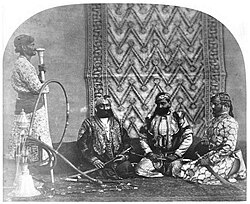
According to early Sanskrit and Persian references, this title was linked to powerful Aryan warriors and clan leaders. Over centuries, different scripts wrote this name without vowels (as GRJR, GRTR), which is why the same community appears in Greek, Persian, and Middle Eastern texts as Gugar, Gargar, Gurjan, Gorgene, Gogi, Gutian, and Gargarian.
This shows how widespread the Gurjar presence was across continents.
3. The Gurjara-Pratihara Empire
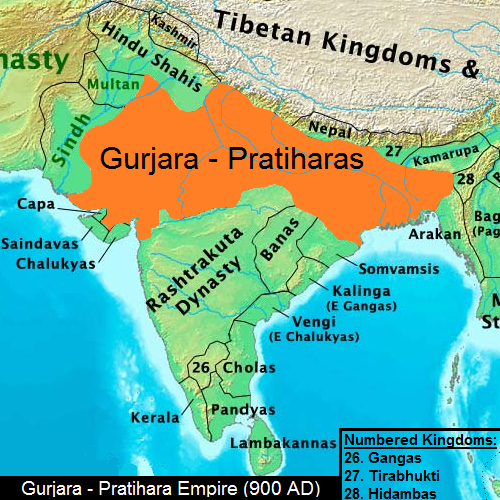
One of the most significant historical legacy of our community is linked to the Gurjara-Pratihara Dynasty, which ruled much of Northern India from the mid-8th to the 11th century. They acted as a bulwark against Arab invasions for nearly 300 years.
Samrat Mihira Bhoja (c. 836–885 CE): Often considered the greatest ruler of the dynasty, Mihira Bhoja’s empire stretched from the Sutlej River in the northwest to Bengal in the east, and from the Himalayas to the Narmada River. He was known as a great administrator and conqueror who maintained a massive standing army, particularly famous for its cavalry. He adopted the title Adivaraha (a devotee of Vishnu).
Nagabhata I (c. 730–760 CE): The founder of the imperial Gurjara-Pratihara dynasty. He is historically celebrated for defeating the Arab armies of the Caliphate during the Battle of Rajasthan, effectively stopping the Islamic conquest of India for centuries.
4. Gurjars during British Rule
The Gurjar community played a vital and often under-recognized role in the fight against British colonial rule, particularly during the 1857 uprising and the peasant movements.
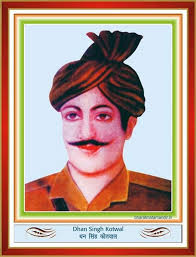
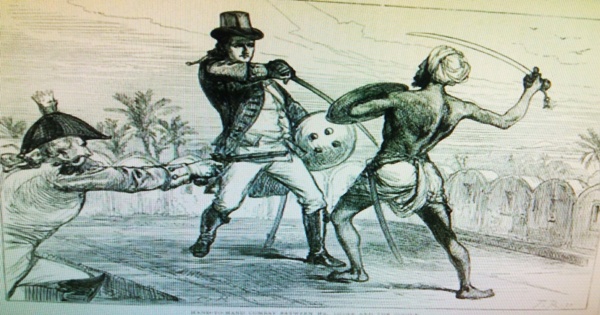
Dhan Singh Gurjar (Kotwal): A key figure in the Indian Rebellion of 1857. As the Kotwal (police chief) of Meerut, he is credited by many historians with initiating the revolt in Meerut on May 10, 1857. He reportedly opened the jail gates, releasing hundreds of imprisoned rebels and leading a group of villagers to fight against the British East India Company.
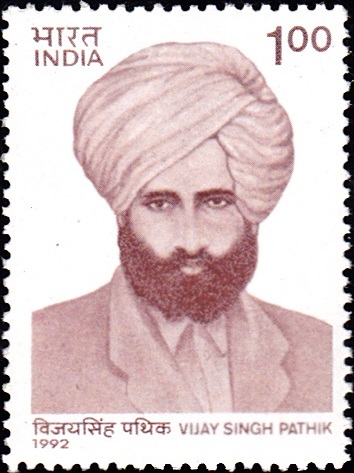
Vijay Singh Pathik (born Bhoop Singh Gurjar): A legendary revolutionary and satyagrahi, he is regarded as the “Father of the Peasant Movement in India.” Born in Bulandshahr, he led the famous Bijolia Kisan Andolan in Rajasthan against unfair taxation by feudal lords and the British. He was a contemporary of Gandhi and Tilak, and a fierce advocate for farmers’ rights.
Raja Nahar Singh (1823–1858): The ruler of the princely state of Ballabhgarh (in modern-day Haryana). He was a key leader in the 1857 War of Independence, guarding the borders of Delhi and supporting Emperor Bahadur Shah Zafar. He was eventually captured and hanged by the British in Chandni Chowk.
5. Gurjars in India
When the Aryans entered the Indian subcontinent, Gurjars became one of the main carriers of Vedic culture and Sanskrit learning. Many important rulers and clans are linked to Gurjar ancestry. Their greatest Indian empire was the Gurjara-Pratihara Empire, which for many centuries defended India from foreign invasions and maintained one of the most powerful armies of its time.
Arab chroniclers wrote that the Gurjars were “the greatest enemy of foreign invaders and the most powerful in cavalry strength.”
6. Warriors
Because Gurjars strongly resisted religious conversion, invasions, and cultural domination, they were often targeted by surrounding powers.
Sumerians, Greeks, Islamic writers, and even medieval European chroniclers described Gurjars as powerful mountain fighters who would not surrender easily. This led to centuries of conflict but also preserved the purity of their heritage.
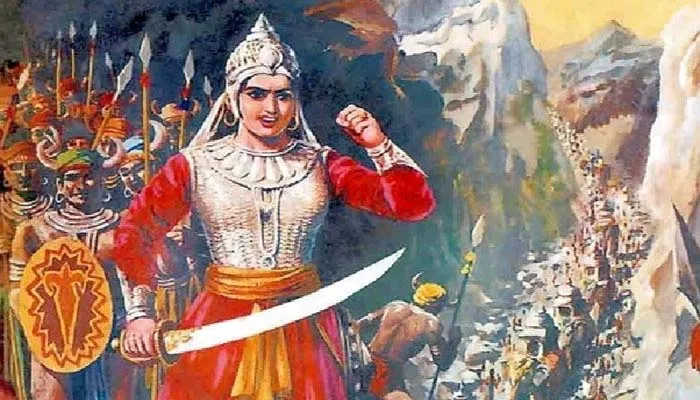
Rampyari Gurjar: A revered figure in North Indian folklore (particularly in the Saharanpur/Haridwar region). According to oral tradition, she was a warrior who led a force of 40,000 women to fight against the invading army of Timur (Tamerlane) in 1398. While standard academic texts often lack detailed records of this event, her bravery is a central part of community heritage.
7. Gurjars in Religion & Culture
Ancient Hindu texts also connect Gurjars to important figures:
- Goddess Gayatri is said to have belonged to the Chechi (Checha) clan of Gurjars.
- Radha, beloved of Krishna, is described as the daughter of King Vrish-Bhanu of a Gurjar clan.
- Many Indian folk songs still address a beloved woman as “Gujari” or “Gujariya”, preserving this cultural memory.
8. Gurjars Today
In contemporary India, the Gurjar community remains a distinct and influential social group, particularly in North and West India. While they hold on to their historical martial and pastoral pride, their modern identity is defined by a transition into politics, agriculture, and urban business.
Geographic Distribution & Occupation
- North Indian Belt: The community is most concentrated in Rajasthan, Uttar Pradesh (Western UP), Haryana, Madhya Pradesh, and Delhi-NCR.
- Pastoral Roots vs. Modern Wealth:
- In J&K and Himachal Pradesh: Many Gurjars (often known as Gujjars & Bakarwals here) continue their traditional semi-nomadic lifestyle, rearing buffalo, sheep, and goats.
- In Delhi-NCR & Haryana: With the expansion of cities like New Delhi, Noida, and Gurgaon, many Gurjar families who were traditional landowners have transitioned into real estate, business, and education, becoming one of the most economically affluent communities in the capital region.
Political Influence
The community is a formidable political force, often acting as a “swing vote” in elections in Rajasthan and Western Uttar Pradesh.
Key Figures:
- Sachin Pilot: A senior leader in the Indian National Congress and former Deputy Chief Minister of Rajasthan, he is currently the most prominent face of the community on the national stage.
- Krishnapaal Gurjar: A prominent leader and Minister of State in the central government.
Cultural Identity
Despite modernization, the community maintains strong cultural ties. Their language, Gojri, is still widely spoken, particularly in Jammu & Kashmir and parts of Pakistan, where it is recognized for its rich oral tradition of folklore and songs.